

After a breakup, your emotions can feel all over the place. One moment you are thinking about them nonstop, and the next you feel completely numb. You may find yourself replaying memories, checking your phone, or wondering why it is so hard to move on.
You might be asking yourself why you cannot let go or why you still feel so attached. Or maybe you are confused because you feel distant, like your heart has shut down.
There is a reason for all of this. The way you are feeling is not random, and it does not mean something is wrong with you.
In this post, you are going to learn how to identify your attachment style after a breakup so you can start to understand your emotions and begin healing with clarity.
What Is an Attachment Style?
Your attachment style is the way you connect with people you care about. It shapes how you love, how you react when things feel uncertain, and how safe or unsafe you feel in a relationship.
You may not notice it at first, but it shows up in small ways. It shows up in how you text back, how you handle distance, and how you respond when someone pulls away or gets close.
Your attachment style did not come from nowhere. It was shaped over time by your early experiences and past relationships. The way love was shown to you, the way people stayed or left, and the way you learned to protect your heart all played a part.
If you learned that love felt uncertain, you may hold on tightly. If you learned that being open led to hurt, you may pull back. These patterns were your way of coping and keeping yourself safe.
Now this is the important part. This is not who you are, but rather simply something you learned. Your attachment style is a pattern, not your identity. And because it was learned, it can also be unlearned and healed.
Understanding this is the first step. It helps you move from blaming yourself to finally understanding yourself.
Step 1: Notice How You Reacted After the Breakup
The first step is to slow down and look at how you actually responded after the breakup. Not how you think you should feel, but how you truly feel and behave.
This is where you begin to see your pattern.
Take a quiet moment and think back to those first days or weeks. Be honest with yourself, without judging anything that comes up.
Did you feel anxious and desperate to reconnect?
Did you keep checking your phone, hoping they would reach out?
Did your mind keep replaying everything, trying to fix it?
Or did you shut down and avoid your emotions?
Did you distract yourself, stay busy, or act like it did not affect you?
Did you tell yourself you were fine, even if you had not really processed it?
Maybe you felt both.
Did you go back and forth between missing them deeply and wanting space?
Did your emotions feel intense one moment and distant the next?
Or you may have felt sad but still grounded.
Did you allow yourself to feel the pain without losing yourself in it?
Did you slowly begin to accept what happened, even though it hurt?
There is no right or wrong response here. Each reaction is simply giving you information about how you are wired in relationships.
Your breakup response is one of the clearest ways to identify your attachment style. When you understand how you reacted, you begin to understand yourself more deeply.
Read More: The 7 stages of grief after a breakup and how to move through them gently
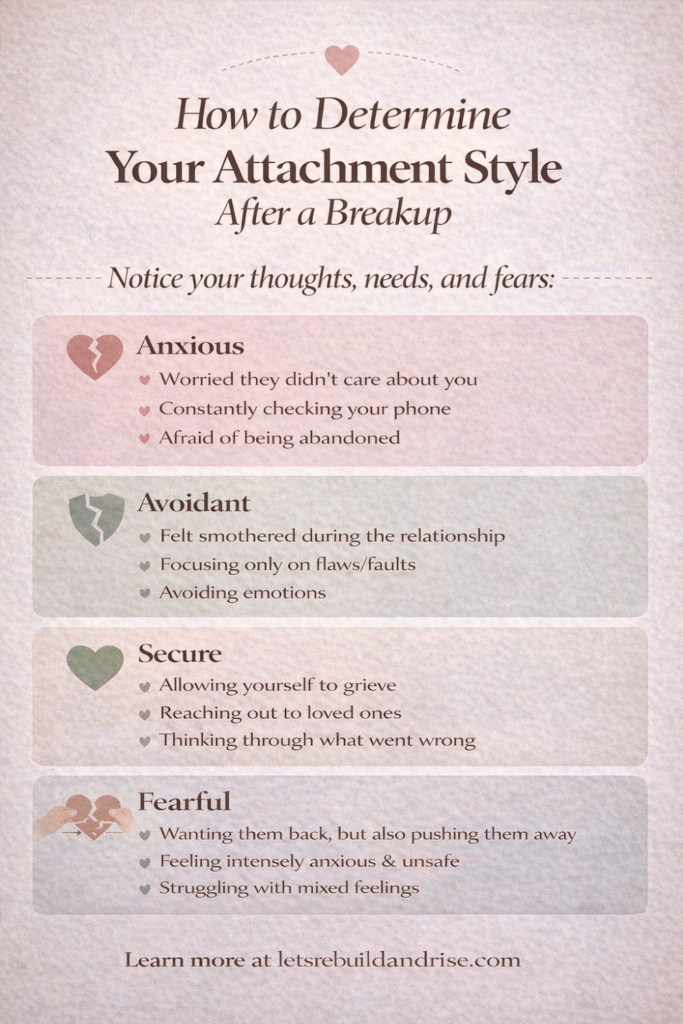
Step 2: Match Your Patterns to the 4 Attachment Styles
Now that you have looked at how you reacted, the next step is to see which pattern feels most like you. You may see yourself clearly in one, or you may relate to parts of more than one. That is normal. Focus on what shows up most often for you.
1. Anxious Attachment
If you have an anxious attachment style, you deeply value closeness and connection. You care a lot, and when that connection is threatened, it can feel very intense.
After a breakup, your mind may stay focused on them. You may find yourself thinking about what went wrong, what you could have done differently, or how to fix it. There may be a strong urge to reach out, check on them, or reconnect in some way.
Letting go can feel very hard. It may feel like a part of you is still holding on, even when you know it is over. This does not mean you are weak. It means your heart learned to hold on tightly to feel safe.
2. Avoidant Attachment
If you have an avoidant attachment style, you protect yourself by keeping some emotional distance. You value independence and may find it hard to fully open up.
After a breakup, you may shut down or move on quickly on the outside. You might keep yourself busy, distract yourself, or avoid thinking about the relationship altogether.
To others, you may seem completely fine. But deep down, the feelings may still be there, just not fully faced or processed. This is your way of protecting yourself from pain.
3. Fearful-Avoidant Attachment
This style can feel confusing because it holds two opposite feelings at the same time. You want love and closeness, but you also fear getting hurt.
After a breakup, your emotions may feel like a push and pull. One moment you miss them deeply, and the next you feel like you need distance. You may go back and forth between wanting to reach out and wanting to stay away.
This can feel overwhelming. Your heart wants connection, but it is also trying to protect you at the same time.
4. Secure Attachment
If you have a secure attachment style, you feel comfortable with both closeness and independence. You are able to connect with others, but you also stay grounded in yourself.
After a breakup, you are not unaffected; you feel the pain, but you allow yourself to process it in a healthy way. You do not lose yourself in the process.
Over time, you begin to accept what happened and move forward. Healing feels steady, even if it is not always easy.
Pin For Later!
Why Identifying Your Attachment Style Changes Everything
When you understand your attachment style, things start to make sense.
You stop blaming yourself. Instead of thinking something is wrong with you, you begin to see that your reactions were learned ways of protecting your heart.
You gain clarity. Your emotions no longer feel confusing because you understand why you felt and acted the way you did.
You start to notice your patterns. You may realize this is not the first time you have felt this way in a relationship.
And most importantly, you can begin to change. Awareness helps you break the cycle so you can move toward healthier, more secure relationships.
In the next post, I will show you exactly how to heal your attachment style step by step so you can begin to feel more at peace in yourself and in your relationships.
Read More: How to heal your attachment style after a breakup
With Love,
Dr. Janet