

In the last post, you learned how to identify your attachment style and understand your patterns after a breakup. That is a powerful first step.
But you may still feel stuck. You might notice your reactions, yet still find yourself overthinking, shutting down, or going back and forth in your emotions. This is normal. Awareness alone does not change your behavior.
That is where this post comes in.
In this guide, you will learn how to heal your attachment style step by step so you can feel more secure, more at peace, and more in control of your emotions as you move forward.
Why Awareness Alone Isn’t Enough
Knowing your attachment style is a great start, but it is only the first step. It helps you understand yourself, but it does not automatically change how you feel or react.
That is because your patterns are not just in your thoughts. They are emotional and automatic. They show up before you even have time to think. You may tell yourself to stay calm, but your body still feels anxious. Or you may know you should open up, but you still shut down.
If nothing changes, the same cycle repeats. You may enter new relationships with the same fears, the same reactions, and the same outcomes. This is not because you are failing. It is because the pattern has not been changed yet.
The simple truth is this. You do not heal by understanding alone. You heal by practicing new responses, even when it feels unfamiliar. Over time, those new responses become your new pattern.
The Goal is Moving Toward Secure Attachment
Now that you understand your patterns, you may be wondering what healing actually looks like. The goal is not to become perfect. The goal is to move toward a more secure way of loving.
Secure attachment feels calm and steady. You do not feel like you are constantly chasing or pulling away. You feel safe being close to someone, but you also feel okay being on your own.
You do not lose yourself in the relationship. You still know who you are, what you need, and what you deserve. You are able to give love and receive love without fear taking over.
This kind of love does not feel confusing or overwhelming. It feels peaceful, even when things are not perfect.
Through this, I want you to remember that you are not trying to become someone new or fix yourself; you are becoming a more secure version of who you already are.
Step 1: Regulate Your Emotions First
Before you try to change your relationship patterns, you need to learn how to steady your emotions. This is where healing begins.
When emotions feel intense, it is easy to react without thinking. You may text, withdraw, overthink, or shut down. These reactions feel automatic, but they come from your body feeling overwhelmed.
So the first step is not to fix everything. It is to slow things down.
Start by pausing before you react. Give yourself a moment. Even a few seconds can help you respond more calmly instead of acting on impulse.
Take a slow breath in, then breathe out gently. Do this a few times and allow your body to settle. You can also ground yourself by noticing where you are and what is around you.
You can bring God into this moment, too. When your emotions feel heavy, pause and say a simple prayer. It can be as simple as, “God, help me feel calm right now.” You do not have to carry it all on your own.
Journaling can also help. Instead of acting on your thoughts, write them down. Let everything out. This gives your emotions a safe place to go.
Most importantly, allow yourself to feel what you feel. You do not need to run from it or pretend you are okay. Sit with it, breathe through it, and remind yourself that it will pass.
Read More: How to let God comfort you after betrayal
Step 2: Heal Based on Your Attachment Style
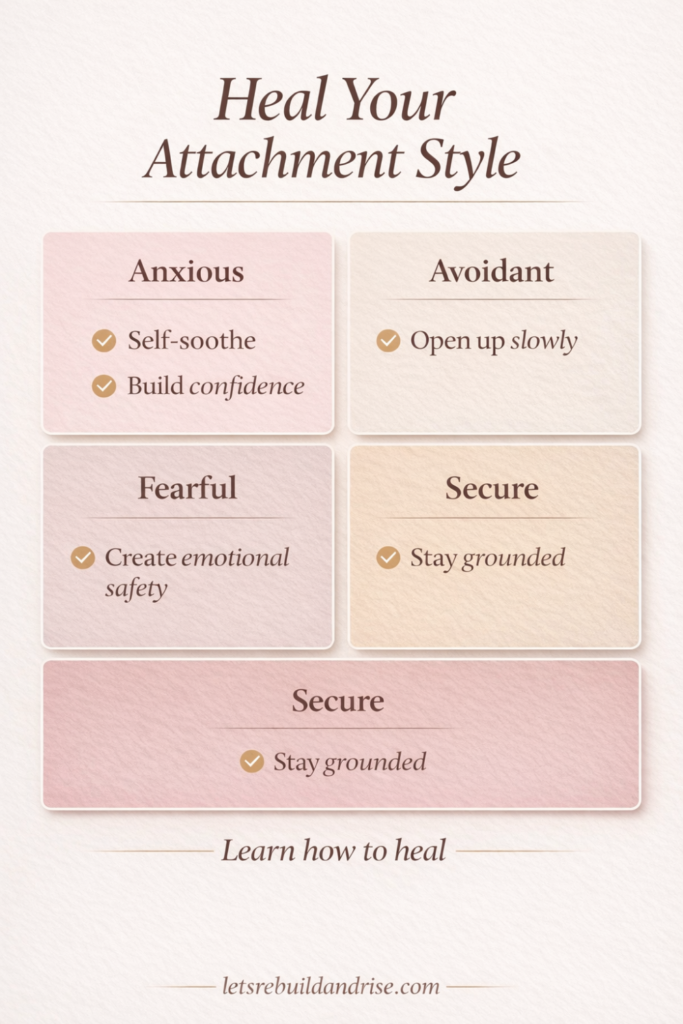
Now that you know your attachment style, you can begin to heal in a way that fits you. Healing is not one size fits all. Each style needs something slightly different.
Anxious Attachment
If you have an anxious attachment style, your focus is on learning how to feel safe within yourself.
Start by learning to self-soothe. When you feel the urge to reach out or seek reassurance, pause and calm yourself first. Remind yourself that you are okay, even if things feel uncertain.
Work on building your self-worth outside of relationships. Spend time doing things that make you feel confident and fulfilled. The more secure you feel within yourself, the less you will depend on others for that feeling.
Practice giving space without panic. This may feel uncomfortable at first, but space does not mean you are being abandoned. It simply means you are learning to trust yourself.
Avoidant Attachment
If you have an avoidant attachment style, your focus is on learning to open up safely.
Start small. You do not have to share everything at once. Practice expressing your thoughts and feelings little by little.
Allow yourself to feel instead of shutting down. When emotions come up, try not to push them away. Sit with them, even if it feels unfamiliar.
Stay present instead of distancing. Notice when you feel the urge to pull away and gently bring yourself back. You do not have to run from connection to stay safe.
Fearful-Avoidant Attachment
If you have a fearful-avoidant style, your focus is on creating emotional safety within yourself.
Notice your push and pull patterns. Pay attention to when you want closeness and when you suddenly want distance. Awareness helps you pause before reacting.
Work on feeling safe in your own emotions. You can want love and still feel safe. Both can exist together.
Take small steps toward consistency. You do not need to change everything at once. Even small, steady actions will help you feel more balanced over time.
Secure Attachment
If you already have some secure traits, your focus is on maintaining and strengthening them.
Continue your healthy habits. Keep communicating, setting boundaries, and taking care of yourself.
Stay grounded during emotional moments. Even secure people feel pain, but they do not lose themselves in it.
Maintain your boundaries and self-respect. Healthy love includes both closeness and balance.
Pin for later!
Step 3: Rebuild Your Self-Worth
After a breakup, it is easy to question your worth. You may start to think that the way someone treated you says something about who you are. But it does not.
Their actions are not a measure of your value. You have to begin to separate your worth from how someone showed up for you.
Start by changing how you speak to yourself. Notice your thoughts. If you catch yourself being harsh or critical, gently shift it. Speak to yourself with kindness, the same way you would comfort a close friend.
You can also rebuild trust in yourself by keeping small promises each day. This could be something simple like getting out of bed when you said you would, going for a walk, or taking time to rest. These small actions remind you that you can rely on yourself.
As you do this, something begins to change. You start to feel more steady, more grounded, and more secure within.
The simple truth is this. The more secure you feel within yourself, the healthier your relationships become.
Read More: How to reclaim your identity after a breakup or divorce
Step 4: Set Healthy Boundaries
Healthy boundaries help you feel safe and respected in your relationships. They protect your time, your energy, and your emotions.
Start by noticing your usual pattern. You may overgive and say yes to everything, even when you feel tired or overwhelmed. Or you may do the opposite and pull away completely when things feel too much.
Healing means finding a balance.
Practice saying no when something does not feel right for you. It may feel uncomfortable at first, but you do not need to explain yourself too much. A simple and kind no is enough.
Pay attention to what drains you and what gives you peace. Choose more of what brings you calm, and step back from what takes too much from you.
As you do this, you begin to protect your emotional energy. You feel less overwhelmed and more in control of your space.
Remember that boundaries are not rejection; They show self-respect, and that you value yourself and the life you are building.
Read More: How to stop overgiving in relationships without becoming cold
Step 5: Rewire Your Dating Patterns
As you begin to heal, the way you approach dating will start to matter more. Old patterns can feel very familiar, even when they are not good for you. That is why this step is so important.
Start by slowing down. You do not need to rush into emotional closeness. Take your time to get to know someone and how they show up. Give yourself space to think clearly instead of getting swept up too quickly.
Practice observing instead of chasing. Notice how they communicate, how consistent they are, and how they treat you. Let their actions speak, rather than trying to fill in the gaps yourself.
Choose what is healthy, not just what feels familiar. You may feel drawn to certain patterns because they remind you of what you are used to, but that does not always mean they are right for you.
Remind yourself of this often; familiar does not always mean safe.
When you slow down, observe, and choose with intention, you begin to create space for a healthier kind of love.
Step 6: Ground Yourself
As you heal, it is important to stay grounded, not just in your actions, but in your heart and mind. This is where your faith becomes your anchor.
Spend time with God, even in simple ways. You do not need perfect words. Just come as you are. Sit in His presence, be still, and allow yourself to feel supported.
When your emotions feel heavy, pray through them. You can say what you feel honestly. You can ask for peace, strength, and clarity. You are not meant to carry everything on your own.
Sometimes it helps to have gentle guidance during these moments. You can use simple devotionals, scriptures, or quiet reflections to steady your heart when your emotions feel overwhelming.
As you do this, begin to notice your thoughts. Many of them may come from fear. Thoughts like “I am not enough” or “I will be left again” can feel very real, but they are not the truth.
Gently replace those thoughts with truth. Remind yourself, “I am safe even when things do not work out.”
Tell yourself, “I am not abandoned, I am being redirected.”
Over time, your mind becomes calmer, your heart feels steadier, and your healing feels more peaceful.
Read More: How to identify your attachment style after a breakup
With Love,
Dr. Janet