

A breakup does not just end a relationship. It can feel like losing your routine, your sense of stability, and the version of life you thought you were building. It can leave you feeling unsettled, emotional, and unsure of who you are without that connection.
What you are feeling is real grief. It’s not an overreaction or a weakness; it’s just a human response to loss.
The truth is, healing after a breakup is not a straight path. You may feel strong one day and overwhelmed the next. You may move forward, only to find yourself revisiting old feelings. That does not mean you are going backward. It simply means you are processing.
In this post, we will walk through the seven stages of grief after a breakup. Not to rush you through them, but to help you understand what is happening within you. Because when you understand your emotions, you can move through them with more gentleness, more patience, and more peace.
Stage 1: Shock
This is often the first response to a breakup, especially if it was unexpected. Everything can feel unreal, like you are moving through your day without fully being present.
You might feel emotionally numb or disconnected, or simply frozen and unsure of what to do next. Even small tasks can feel harder because your mind is still trying to process what has happened.
This stage is your mind’s way of protecting you from too much pain all at once. It gives you space to slowly take things in, rather than becoming overwhelmed.
For now, keep things simple. Focus on rest, food, and a gentle routine. You do not need to have answers yet. Just take things one moment at a time.
As the numbness begins to lift, your feelings may start to surface more clearly, leading you into the next stage.
Read More: To the Woman Who Just Had Her Heart Broken: This Is for You
Stage 2: Denial
As the shock begins to settle, denial can step in quietly. Part of you may still struggle to accept that it is really over. You might hold onto hope that things will work out, or you might focus only on the good moments.
You may minimize what happened or replay the relationship in a softer way. This can make it harder to fully face the reality of the breakup.
At its core, denial is your heart trying to protect you from the pain of loss. Letting go can feel too heavy, so your mind gives you more time.
To move through this stage, start with gentle honesty. Acknowledge what is true without being hard on yourself. It also helps to reduce triggers like checking their social media or rereading old messages, as these can keep you emotionally attached.
Acceptance is not about agreeing with what happened. It is about choosing peace. And as that truth begins to settle, your emotions may start to shift into the next stage.
Stage 3: Anger
As the reality of the breakup settles in, anger can begin to rise. You may feel frustrated, resentful, or overwhelmed by thoughts about what went wrong. At times, that anger may be directed at them, and at other times, it may turn inward, leaving you blaming yourself.
You might find yourself replaying arguments, going over conversations, or wishing things had unfolded differently. Underneath it all, anger is often covering a deeper hurt. It gives you a sense of control in a situation that may have felt confusing or painful.
The most important thing in this stage is to release that anger in a safe way. You can write it out, pray through it, or talk it through with someone you trust. Let yourself feel it without letting it lead you into impulsive reactions or decisions.
Anger is a natural part of the process, but it is not meant to stay. As you allow it to pass through you, it begins to soften, making space for deeper reflection and the next stage of healing.
Read More: How to let go of anger after divorce without ignoring the pain
Stage 4: Bargaining
As your emotions begin to settle, your mind may start searching for ways to go back and change what happened. You might find yourself thinking about what you could have done differently or imagining how things could still work out.
This can show up as wanting to fix things, replaying different outcomes, or feeling a strong urge to reach out and reconnect. It can feel like one conversation might change everything.
At its core, this stage is about trying to undo the loss. Your heart is not quite ready to let go, so it looks for ways to hold on.
To move through this stage gently, notice these thoughts without acting on them. Give yourself space to pause. Not every urge needs a response.
Remind yourself that closure does not always come from the other person. Sometimes, it is something you give yourself.
Instead of reaching outward, begin to bring that energy back to you. As you do, the pull to go backward slowly eases, making space for deeper healing.
Pin For Later!
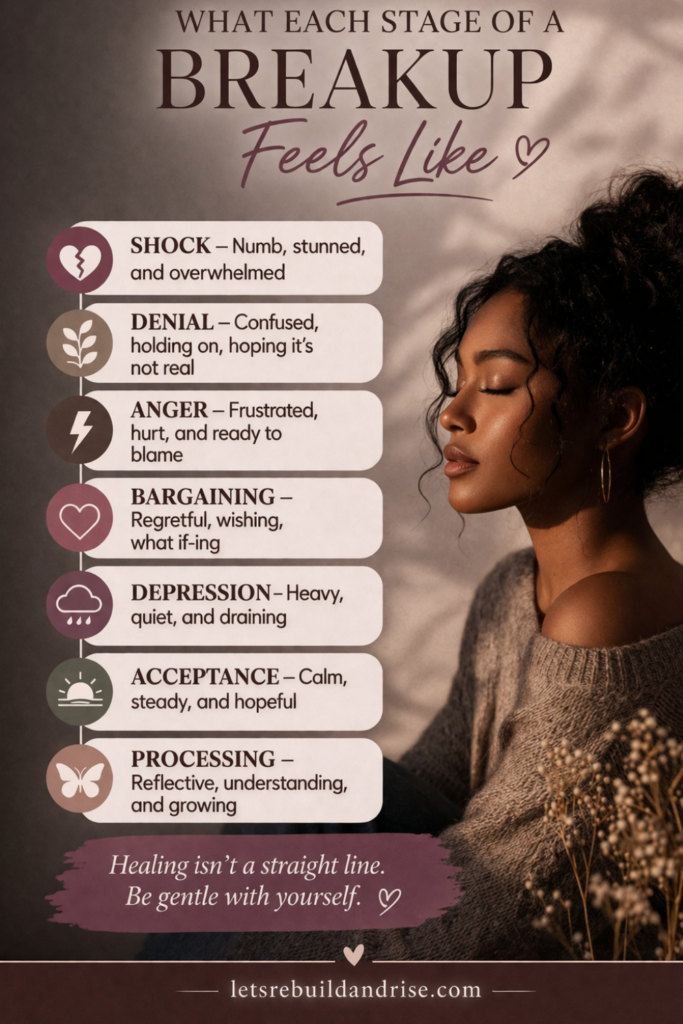
Stage 5: Depression
At this stage, the reality of the breakup begins to settle in more deeply. The distractions fade, and you may start to feel the full weight of the loss.
You might experience deep sadness, low energy, and a lack of motivation. Even simple things can feel harder, and there may be moments when you feel empty or stuck.
This is a natural part of grief. Your heart is processing what it has lost.
The most helpful thing here is to keep things gentle. Focus on small daily wins like getting up, eating, or stepping outside. Allow yourself to rest without guilt, but try to stay lightly connected to someone you trust so you do not feel completely alone.
If you need something to hold onto during this stage, your Healing Devotional can offer comfort and guidance on the days that feel heavier.
Stage 6: Acceptance & Hope
At this stage, something begins to shift. The pain may still be there, but it feels lighter and more manageable. You start to experience moments of peace, and slowly, you begin to feel like yourself again.
Your emotions are less intense, and you may find yourself believing, even quietly, that you will be okay. This is a sign that you are releasing resistance and making space for healing.
To move through this stage gently, reflect on what you have learned and begin rebuilding simple routines that support you. Allow hope to exist, even if it feels small at first.
This is also a powerful time to reconnect with who you are. If you are ready, your Reclaiming Me Devotional can help you rebuild your identity and confidence as you move forward.
As hope grows, you naturally begin to step into the next stage of healing.
Stage 7: Processing Grief
At this stage, you begin to make sense of everything you have been through. The emotions feel calmer, and you are able to reflect with more clarity.
You may start to understand your patterns, recognize your needs, and see the relationship more honestly. Letting go begins to feel intentional rather than forced.
What is happening here is growth. You are integrating the experience into your story in a way that strengthens you.
To move through this stage gently, take time to reflect and journal your journey. Allow forgiveness at your own pace, without pressure. Begin choosing yourself more fully by setting boundaries and honoring your self-worth.
As you move through these stages, it is important to remember that healing does not follow a straight line. You may feel like you have made progress, only to find yourself revisiting an earlier stage. That does not mean you are going backward. It simply means you are processing more deeply.
Healing also does not mean forgetting. It does not erase what happened or what you felt. Instead, it allows you to carry your experiences without them weighing you down.
Give yourself permission to take your time. There is no deadline for healing, no perfect pace, and no right way to move forward. Your journey is your own, and it deserves patience and kindness.
With Love,
Dr. Janet